



AI Agents: The Complete 2026 Guide for Businesses in India
In 2026, AI agents have moved from experiment to infrastructure. They answer calls at midnight, follow up on enquiries in Hindi and Gujarati, and quietly run the repetitive work that used to need a full team. For businesses across India, where a missed call at 6:15 pm is often a lost customer forever, this shift is not a distant trend. It is a competitive advantage available today. This guide explains what AI agents are, how they work, the types and real-world examples, how they differ from chatbots, and, crucially, what they mean specifically for Indian businesses.
What Is an AI Agent?
An AI agent is an autonomous software program that collects data about its environment, decides the best actions to reach a defined goal, and executes those actions on its own. Humans set the objective; the agent independently chooses how to achieve it.
For example, a customer-service AI agent can verify a caller's identity, look up their order, apply a refund policy, and send a confirmation, all without a human touching the ticket. This is the core distinction that matters. Traditional automation follows a fixed script: if X, then Y. An AI agent reasons across steps, handles ambiguity, calls external tools, and adjusts its behaviour based on outcomes. A genuine AI agent is "goal-directed": it works toward an objective, not just executes a fixed script.
AI Agents vs Traditional Software, Bots & RPA
Robotic Process Automation (RPA) is excellent for predictable, rule-based tasks but breaks when conditions change. A rules-based chatbot follows pre-set dialogue trees. An AI agent sits above both: it understands natural language, reasons about intent, and can orchestrate RPA bots and APIs as tools to get work done. Many real deployments combine them: RPA for the repetitive click-work, an AI agent for the judgement.
Key Characteristics of an AI Agent
- Autonomy: operates with minimal human supervision
- Perception: ingests data from conversations, documents, APIs, sensors
- Reasoning & planning: breaks a goal into steps
- Memory: retains context across a conversation and over time
- Action & tool use: executes tasks: sends messages, updates records, processes payments
- Learning: improves from feedback and outcomes
How Do AI Agents Work?
Every AI agent runs a continuous loop: perceive → reason → plan → act → learn. It gathers information about its situation, reasons about what to do, breaks the goal into smaller tasks, performs those tasks using available tools, and adapts based on the result, repeating until the objective is met.
The Core Components
The core (an LLM)
The "brain" that processes language and reasons, using models such as GPT, Claude, or Gemini.
Memory
Short-term (current context) and long-term (vector databases storing past interactions and business knowledge).
The planner
Decomposes a goal into an ordered set of actions.
Tools
APIs, databases, calendars, CRMs, and RPA robots the agent can call to act in the real world.
What MCP (Model Context Protocol) Changed
Before MCP, connecting an agent to each tool meant custom integration code for every model-tool combination, fragile and expensive at scale. MCP, an open standard introduced by Anthropic, gives AI applications a shared interface to connect to tools and data, often compared to USB-C for AI. By 2026, most major frameworks and enterprise tools offer native MCP compatibility, which is why building capable agents is faster and more reliable than it was even a year ago.
Types of AI Agents (With Examples)
AI agents are classified by how they make decisions. There are five foundational types, plus multi-agent systems where several specialised agents collaborate.
Simple reflex agents
Act on the current input using fixed condition-action rules; no memory.e.g. a thermostat, or a threshold alert
Model-based reflex agents
Maintain an internal model of the world to handle partially observable situations.e.g. inventory forecasting
Goal-based agents
Evaluate future outcomes and choose actions that achieve a specific goal.e.g. a route planner, or resolving "Refund order #12345" end to end
Utility-based agents
Weigh trade-offs by assigning a utility value to outcomes.e.g. a self-driving car balancing speed, safety and fuel efficiency
Learning agents
Continuously improve from feedback.e.g. reinforcement-learning trading bots
Multi-agent systems
Several specialised agents collaborate: one plans, another executes, a third checks, outperforming single agents on complex tasks.
AI Agents vs Chatbots: What's the Difference?
A chatbot follows rules-based dialogue and answers predefined questions. An AI agent reasons, grounds answers in your business knowledge, and takes autonomous action across steps and channels. The real distinction is automation (answering) versus autonomy (completing the task).
| Chatbot | AI Agent | |
|---|---|---|
| Logic | Pre-set scripts, keyword matching | Reasons, plans, decides |
| Behaviour | Reactive, waits for input | Proactive, can initiate & act |
| Scope | Answers questions | Completes workflows end to end |
| Learning | Static; needs manual retraining | Adapts from interactions |
| Example | FAQ widget | Books the appointment, updates the CRM, sends the confirmation |
AI Agents for Business: Use Cases
AI agents are being deployed across virtually every function. The best starting points are high-volume, well-defined workflows, and the pattern across research is consistent: AI for volume, humans for value.
Customer service: Agents resolve common requests instantly, execute safe actions (refunds, password resets), and route complex cases to humans with full context. Salesforce, running the world's largest agentic deployment, reports its help site now processes ~32,000 conversations weekly, with Agentforce autonomously resolving about 85% of queries, and the human handoff rate falling from 26% to just 4–5%.
Sales & lead generation: Agents enrich leads, score intent, draft personalised outreach, and update CRM records automatically, freeing sales teams from repetitive tasks.
Operations, logistics & finance: Agents automate dispatch and routing, invoice processing, fraud detection, and predictive maintenance.
AI Agents in India: Adoption, Market & Compliance
India is one of the most receptive markets in the world for AI agents. 93% of Indian business leaders intend to use AI agents within 12–18 months (the highest confidence globally), and 59% already use them to automate workstreams (Microsoft 2025 Work Trend Index).
Multilingual & Voice AI for Bharat
India is not a single-language market. Customers, especially in Tier-2 and Tier-3 cities, prefer Hindi, Hinglish, and regional languages like Gujarati, Tamil, and Marathi. Native-language conversations improve clarity, trust, and conversions. Effective Indian voice AI must handle code-switching ("Saturday 4 baje ka slot confirm kar doon?") within a single conversation, and well-trained systems achieve 85–95% intent-recognition accuracy. Voice matters enormously because Indian buying culture is call-heavy, and customers still prefer to talk before they trust.
DPDP Act, TRAI & DND Compliance
Any AI agent handling Indian customer data operates under the Digital Personal Data Protection (DPDP) Act, 2023. The DPDP Rules 2025 were notified on 13 November 2025, and core operational obligations (notice, consent, security safeguards, breach reporting, and cross-border transfers) become enforceable on 13 May 2027, with no grace period and penalties reaching ₹250 crore for security-safeguard failures. For voice/outbound campaigns, TRAI regulations and DND (Do-Not-Call) rules require scrubbing DND numbers, respecting calling-hour windows, business identification, and audit logs. A credible Indian AI agent vendor builds this compliance in by default, including data residency, encryption, and PII redaction.
AI Agents Across India: Industries That Benefit Most
From metros to Tier-2 and Tier-3 towns, Indian businesses that run on leads, appointments, and repetitive customer calls gain the most from AI agents, capturing every enquiry 24/7 in the customer's own language and following up without a bigger team.
Real estate
Qualify buyers, book site visits, and follow up on enquiries from portals like 99acres and MagicBricks, in Hindi and regional languages.
Healthcare & clinics
Schedule appointments, send reminders, share reports, and answer patient FAQs round the clock, without a full front desk.
Education & coaching
Answer admission enquiries, counsel prospective students, and send fee and class reminders through peak admission seasons.
Retail & e-commerce
Handle order updates, returns, and abandoned-cart follow-ups across WhatsApp, call, and chat, in the customer's language.
Manufacturing & MSMEs
Manage distributor enquiries, GST and document workflows, lead capture, and payment reminders, integrating with tools like Tally.
Finance & insurance
Qualify leads, run KYC and renewal reminders, and answer policy questions, with full audit trails for TRAI/DND compliance.
How to Choose an AI Agent Development Company in India
Not every "AI agent" is a real agent. Many vendors wrap a chatbot in marketing language. When evaluating a partner, look for genuine agentic capability, proven results, and India-first compliance.
- Genuine agentic capability: reasoning, tool use, memory, failure handling, not just scripted flows.
- Proven track record & references: real case studies with measurable outcomes.
- India-first compliance: DPDP, TRAI/DND awareness built in.
- Multilingual depth: true Hinglish and regional-language handling, not a translation layer.
- Integration: connects to your CRM, ERP, WhatsApp, IndiaMART, JustDial, and telephony.
- Fast, transparent deployment: clear scope, timelines, and deliverables.
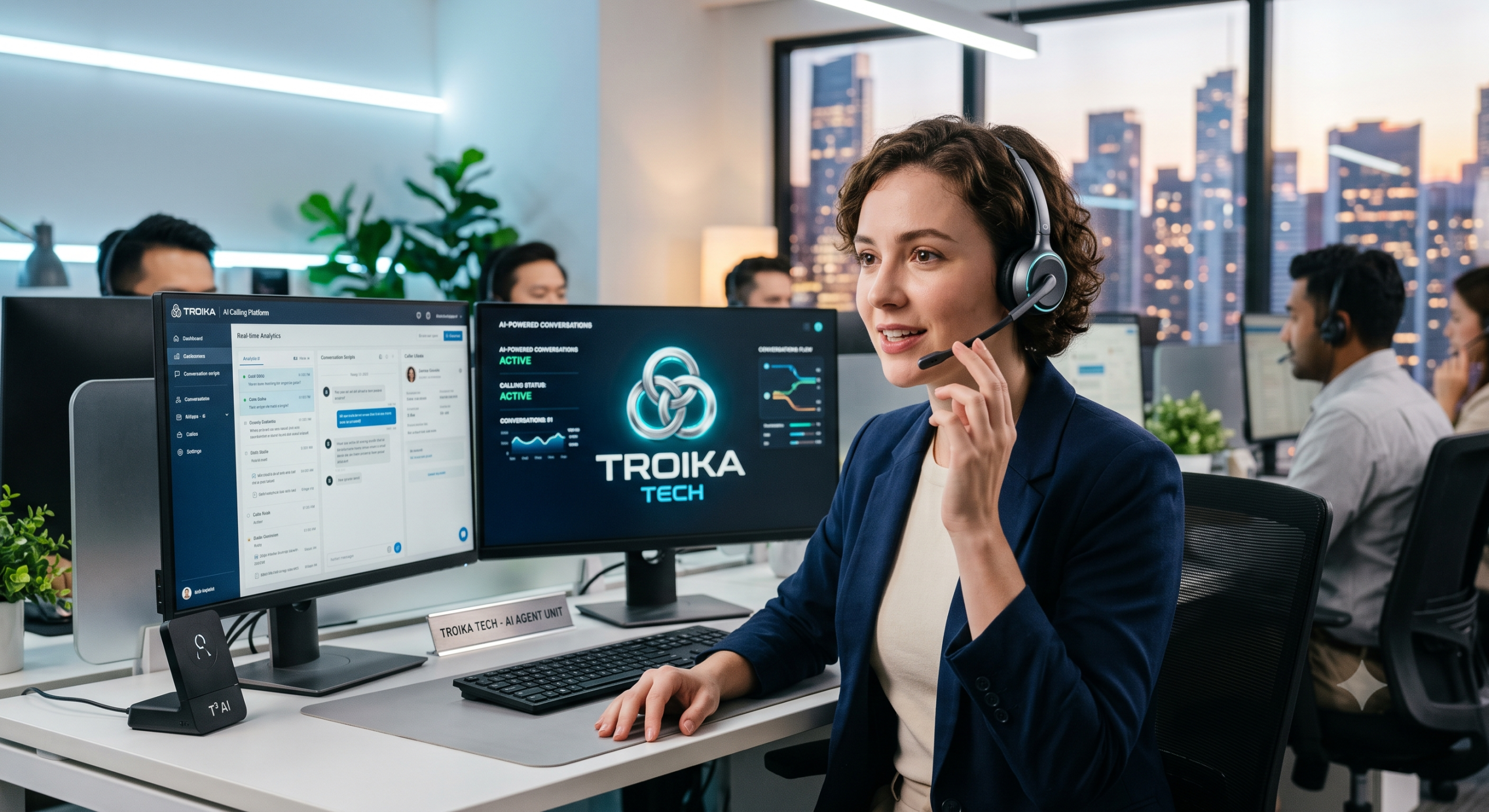
Troika Tech Services, a Mumbai-based company positioning itself as India's first dedicated AI Agents company, is built specifically for these Indian realities, with 13+ years of experience, 6,000+ implementations across 40+ industries, and India-first products including Swara (multilingual voice AI calling agent, TRAI/DND-aware) and OmniAgent (chat agent for WhatsApp, website, and social channels).
How to Get Started with AI Agents
- Identify one high-volume, well-defined workflow: missed calls, lead follow-up, or FAQ support are ideal first candidates.
- Define success metrics: call deflection, response time, conversion rate, cost per interaction.
- Start with a pilot: deploy one agent (voice or chat), measure, then scale.
- Build in compliance and human handoff from day one.
- Expand into a multi-agent system as confidence grows.
Frequently Asked Questions
What is an AI agent?
How do AI agents work?
What are the main types of AI agents?
What is the difference between an AI agent and a chatbot?
What is the difference between AI agents and agentic AI?
What are the main benefits of AI agents for a business?
Is ChatGPT an AI agent?
Are AI agents useful for small businesses and MSMEs in India?
Can AI agents speak Hindi, Gujarati and other Indian languages?
Are AI agents legal and compliant in India?
Do AI agents integrate with WhatsApp, CRM and my existing tools?
How long does it take to deploy an AI agent?
Losing leads because calls aren't answered on time?
An AI voice or chat agent can close that gap permanently. A short consultation with an India-first provider like Troika Tech can map your highest-impact use case and get a pilot live in weeks.
Book a free consultation